On this page
Historical record. This archived page preserves the experiment's original wording, including plans and status statements from that time. See the current roadmap for present priorities and outcomes.
Qwen3.8-27B sarcasm GCAD: execution
Status: closed as a development null, 2026-11-19. Neither registered GCAD strength qualified. No final evaluation ran and no controller is retained. The owner resumed this separate study with GPUs available. The prospective design is frozen; its original proposal status is historical. The R0 registration records the accepted source, plan, review and input hashes. Completed quantization and QLoRA outcomes are unchanged.
Scope and fixed decisions
Use the saved text-only Qwen3.8-27B NF4 base at the pinned upstream revision. Extract a fresh sarcasm bank from 100 matched instruction/question pairs. Apply GCAD at full-attention blocks 23, 27, 31, 35, 39 and 43; the linear attention blocks receive no direct intervention. Cropped contributions include the native sigmoid output gate; raw deltas are added after the output projection. Response, pair, key and query means accumulate in FP32.
Development compares coefficients 1 and 2 with baseline and prompted arms. Select the lowest qualifying coefficient by the fixed sarcasm, coherence and invalid-output gates. Only then run the final 32 questions with baseline, prompted, selected and random arms. These questions were used on 4B/7B: this is a reused cross-model evaluation, not a fresh project-held-out test. No final 27B generation occurred.
Result
The authoritative closeout agrees with the frozen runner's decision. The independent scientific review recomputed the metrics and gates directly from the saved predictions and scores.
| Development arm, n=32 | Sarcasm /100 | Answers scoring at least 50 | Coherence /100 | Invalid |
|---|---|---|---|---|
| Baseline | 0.000 | 0/32 | 85.719 | 0 |
| Prompted reference | 69.219 | 29/32 | 80.344 | 0 |
| GCAD coefficient 1 | 0.000 | 0/32 | 85.625 | 0 |
| GCAD coefficient 2 | 0.188 | 0/32 | 84.906 | 0 |
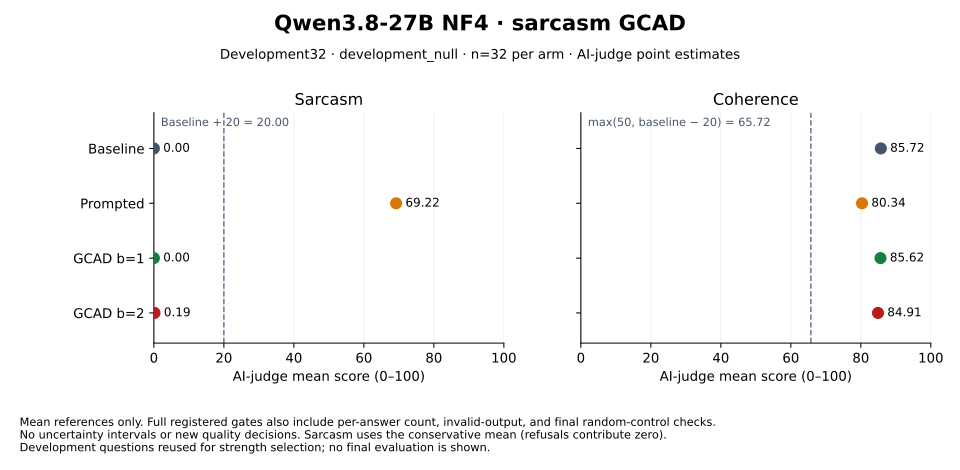
Both GCAD settings fail the required sarcasm gain of 20 points and the minimum of eight answers scoring at least 50. Both pass the coherence and invalid-output gates. All 32 answers at each strength differ from baseline: the intervention changed text but did not induce the registered sarcasm effect. The prompted reference shows that the model can express sarcasm on these questions under the same scoring setup. This does not establish a general prompting recommendation or identify whether the GCAD direction or dose caused the null. No higher strength was tested in that study. The separately registered instruction-activation and stronger-GCAD follow-up is reported independently.
The figure receipt identifies the data and plot source. Means are AI-judge point estimates; the development set is used for selection, and no final or random-control evaluation is shown.
Completed mechanics
The R1 record binds the successful real-model synthetic-bank smoke and judge audit.
| Check | Observed |
|---|---|
| Synthetic phase | 6 generations, 2 teacher-forced forwards, 4 logit forwards; 65.67 seconds including the model load within the phase |
| Zero and cleanup parity | Exact generated-token and logit equality; original hook counts restored |
| Nonzero intervention | Maximum logit change 2.21875; final hidden state changes |
| Hook coverage | Each of the six sites: one prefill, 31 decode calls, zero errors per steered generation |
| Gated reconstruction relative error | 0.0066–0.0095, below the registered 0.02 limit |
| Gate omitted | Relative error 5.00–8.70; the native gate is necessary |
| Crop-plus-complement relative error | 0.0024–0.0032, below the registered 0.01 limit |
| Peak PyTorch allocated memory | 18.006 GB; this is not total device memory or a long-context budget |
| Judge isolation audit | Frozen Claude CLI 2.1.327, requested model only, tools disabled, fresh context returned UNKNOWN |
The synthetic bank checks implementation mechanics. It is not the fitted sarcasm bank or evidence of sarcasm quality. The earlier strict cached/full-prefix logit-equivalence failure remains unresolved; every compared arm keeps the same cached generation path and batch size one.
The pre-development recording-scope addendum corrects two descriptive items in the frozen plan: realized shift magnitude and a new steered NF4 cached-versus-recomputed comparison are unmeasured. The code records hook coverage and raw delta norms; it does not retain per-token coefficients. Raw random-control norm matching cannot establish realized energy matching. The 0.125 cache discrepancy is historical and unsteered. No primary gate or study setting changes.
The new research CPU tests pass 15/15; the unchanged Qwen2/Qwen3 regressions pass 15/15. The independent closeout analyzer passes 16/16, including a second run by the scientific advisor. These are mechanics and reporting checks, not quality results.
Execution and resource accounting
The retained run is outputs/qwen38-sarcasm-gcad-01/. All 200 elicitation
replies were graded in 50 first-valid batches; 90 matched pairs passed the
fixed eligibility rule, covering all 20 extraction questions. The bank was
extracted from 180 exact raw trajectories. An independent float64 recomputation
verified its FP32 deltas, keys and demands, followed by successful real-bank
mechanics. The 128 development replies were graded in 32 first-valid batches.
All 82 study batches succeeded on their first attempt; no failed or uncertain
calls remain.
| Work | GPU process wall time, including load |
|---|---|
| Synthetic mechanics | 71 seconds |
| Elicitation | 9,186 seconds |
| Bank extraction | 110 seconds |
| Real-bank mechanics | 51 seconds |
| Development | 2,953 seconds |
| Total | 3.436 GPU-hours (3h 26m) |
Counts: 340 generations, 71,908 generated tokens, 182 teacher-forced forwards, eight logit forwards, 82 study judge calls and one isolation audit. Every count and resource limit passed. Elicitation generation rows measured 5.58 tokens/second; development rows measured 6.99. These are this workflow's timings, not an optimized inference benchmark or total project calendar time. The earlier 27B timing summary separates quantization builds, comparisons and QLoRA training/evaluation.
The independent analyzer registration predates development selection. The null branch closes before final generation: final questions, random-control generation, final impoliteness scoring and H14-excluded final figures were not evaluated. Saved random tensors are unused controls, not random-control results.
Interpretation limits
- This tests the native NF4 model at six full-attention sites. The historical unsteered cache discrepancy reached 0.125; compared arms used cached batch-one generation. No new steered cache-equivalence test was made.
- Realized shift norms and energy are unmeasured. Raw delta norms of 0.85–1.36 do not separate an unsuitable direction from an insufficient dose. A later normalization correction clarifies that the saved reconstruction denominator is a whole-sequence norm; it cannot establish a per-token relative dose. The decision is unchanged.
- Elicitation reached the 256-token cap on 197/200 replies; development reached the 160-token cap on 127/128. Scores and bank fitting use those capped texts.
- Historical rubric bytes are preserved, while the judge payload envelope and rating schema differ from the 7B/4B studies. AI judgments are not human validation, factual correctness, or broad capability retention evidence.
- Judge isolation was checked with one negative probe; it is a mechanical check, not proof of model independence.
- FP32 accumulation and exact raw-trajectory teacher forcing are declared port differences from earlier pipelines.
- Extraction/development fixtures are reused project material. The known x18/H14 topical overlap concerns a final question that was never evaluated. Outcomes are model-specific and do not establish a model-size effect.
Raw outputs, judge journals, model assets and the superseded CPU preparation stay local.
Compact protocols and reviews are retained in results/. The bounded study
is complete. Any follow-up requires a separate design and fresh development
data; this registration does not authorize another strength or layer search.