On this page
27B sarcasm: results and interpretation
GCAD induced strong judged sarcasm on Qwen3.8-27B at strengths 8 and 16,
with coherence losses that failed the registered acceptance rules. No tested
strength passed all gates. The original study closed as development_null;
the separate stronger-setting follow-up closed as exploratory_null_through_b16.
The published tunable controls are an experimental
demonstration, with strength 8 as the owner-selected default.
For the method shared with the 4B/7B studies, see the trait-steering theoretical background. The model weights remain frozen: GCAD edits attention-output activations during inference.
Behaviour and quality
The original development study compared strengths 1 and 2 on 32 questions. Sarcasm was 0.00 and 0.19, versus 0.00 for baseline and 69.22 for an explicit sarcasm instruction. Neither strength qualified, so its conditional final evaluation never ran. Both settings passed coherence and invalid-output rules; both failed the sarcasm gain and count requirements. Every steered answer differed from baseline. Those development questions were reused from the 4B/7B studies, so this is not a controlled model-size comparison.
The separately registered follow-up used 32 fresh project questions, seven fixed arms and a 160-token cap. These are exploratory development results, without an independent final evaluation. Scores below are blinded AI judgments out of 100; “coherence <50” counts individual answers, not a new acceptance rule.
| Arm | Sarcasm | Sarcasm ≥50 | Coherence | Coherence <50 | Both scores ≥50 | Impoliteness | Gate result |
|---|---|---|---|---|---|---|---|
| Baseline | 0.00 | 0/32 | 84.28 | 0/32 | 0/32 | 1.91 | Reference |
| Explicit sarcasm instruction | 55.56 | 25/32 | 76.00 | 0/32 | 25/32 | 52.09 | Reference |
| GCAD 2 | 0.09 | 0/32 | 84.16 | 0/32 | 0/32 | 2.22 | Fails sarcasm |
| GCAD 4 | 4.97 | 0/32 | 83.44 | 0/32 | 0/32 | 6.75 | Fails sarcasm |
| GCAD 8 | 88.50 | 32/32 | 58.94 | 6/32 | 26/32 | 70.72 | Fails relative coherence |
| GCAD 16 | 95.16 | 32/32 | 34.59 | 30/32 | 2/32 | 81.53 | Fails both coherence rules |
| Random direction 16 | 0.00 | 0/32 | 84.28 | 0/32 | 0/32 | 2.09 | Descriptive reference |
At strength 8, coherence 58.94 <64.28, the required baseline-minus-20 floor; this is its only failed gate. Strength 16 also fails the absolute floor of 50. Invalid-output counts are zero in every arm. All 224 answers reached the cap. Untested intermediate strengths are configurable in the runtime, but no balanced setting has been established.
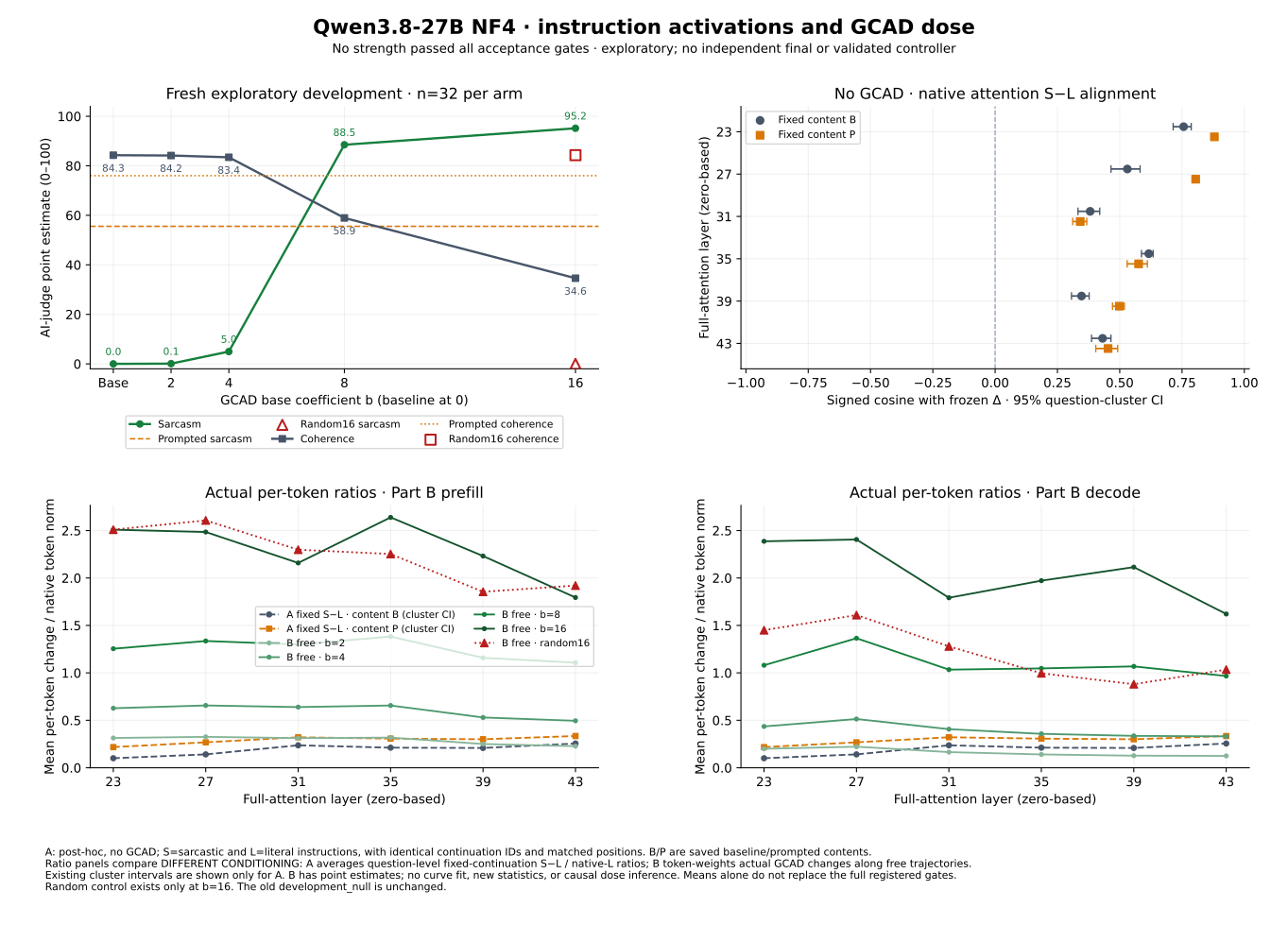
The canonical analysis and independent closeout review retain exact values, all gate booleans and the figure's interpretation limits. Connecting lines do not estimate behaviour at untested strengths.
What explicit instructions change
A post-hoc analysis replayed two saved continuations per old question under sarcastic, literal and absent system instructions: 192 teacher-forced cells. The primary sarcastic-minus-literal contrast held continuation tokens and their positions fixed, with both system prompts adding exactly 45 tokens.
The attention-output changes aligned positively with the bank at all six intervention sites: signed cosines 0.34–0.88, with all question-bootstrap intervals above zero. Paired per-token changes were 10–34% of native literal-context norms; the pooled-mean component was smaller, 3.5–14%. The sarcastic instruction nevertheless lowered the separate GCAD gate at every site, by 0.015–0.075; the gate is a compatibility proxy, not a detector of sarcastic intent. It made the saved sarcastic continuation more likely: mean NLL(S)−NLL(L) was −0.37, versus +0.15 for the saved baseline continuation.
This compares the whole instruction wording, using one pair represented in the bank. It does not isolate a pure sarcasm feature or diagnose the earlier null. Fixed-continuation instruction effects and free-generation steering condition on different sequences. The detailed activation record retains residual profiles, bootstrap details and full shift telemetry.
Measured steering shifts
The follow-up separately recorded the algebraic coefficient-times-delta norm, the rounded requested operand and the actual FP32 output difference. The shared theory defines these quantities. The table gives token-weighted decode actual/native ratios, ranging over the six sites; it describes these trajectories only.
| Arm | Decode actual/native ratio |
|---|---|
| GCAD 2 | 0.13–0.22 |
| GCAD 4 | 0.33–0.51 |
| GCAD 8 | 0.97–1.36 |
| GCAD 16 | 1.62–2.41 |
| Random direction 16 | 0.88–1.61 |
Scope and limits
The profile uses the pinned NF4 base, a bank fitted from 90 eligible matched pairs across five instruction pairs, and six full-attention sites. Generation is single-turn English, without a system prompt, greedy with repetition penalty 1.05, cached batch one and capped at 160 output tokens. Other contexts and backends are untested.
Sarcasm and impoliteness rose together; the study does not establish their separability. Coherence asks whether the answer makes sense in the question's context; sarcasm or rudeness alone should not lower it. These scores do not establish factual correctness or general capability retention, and incoherence is not necessary for sarcasm. The historical coherence rubric's hallucination wording makes the distinction from factual correctness imperfect. These are AI judgments, not human validation.
The random control uses one seed at strength 16 only. It matches the nominal setting and raw delta norms, while realised shifts differ along generated trajectories. The b16-minus-random sarcasm margin is +95.16 points, a descriptive contrast. It does not provide an energy-matched comparison, a random control at strength 8 or a general direction-specificity claim. The old whole-sequence norm interpretation was corrected; the follow-up measures per-token shifts directly. In the original study, 197/200 elicitation answers hit the 256-token cap and 127/128 development answers hit the 160-token cap; scoring and bank fitting use capped text. Results concern convenience questions and one GPU/software stack. The follow-up does not show that the original null was caused by insufficient strength. Strict cached/full-prefix equivalence remains unresolved; compared arms preserve the same cached path.
Study records and reproducibility
The current usage guide gives pinned downloads, tuning and public GPU verification. Detailed historical records remain available:
- Original study: execution and resource accounting, frozen design, authoritative closeout.
- Follow-up: execution and diagnostics, frozen design, registration.
- Project: completed releases and verification.
The original study records 3.44 GPU-hours (conservative charge); the follow-up measured 1.76 GPU-hours. These include model loading and their registered mechanics. The display-rounding erratum corrects three telemetry endpoints repeated in the archived follow-up documents; no gate or outcome changes. Raw trajectories, activation tensors and judge journals remain local; compact results and reviews are public. Consolidating these pages does not change any result or gate.